
HOW WE TRAIN
Our dog training methods:
clear, kind, and practical.
Before you hire a trainer, you should know how they will work with your dog. Here is what Canine Afloat does, what to expect from it, and how safety is handled.
 CANINE AFLOAT · CAPE COD
Where every plan starts
Canine Afloat uses positive, science-based training. We start with positive reinforcement and clear structure: your dog is rewarded for the behavior you want, and the day is set up so that behavior is easy to choose.
Every dog is different, so the plan is adjusted to the dog in front of us. We begin with what your dog can manage today and build at a pace that gives you both a chance to succeed.
What a lesson looks like
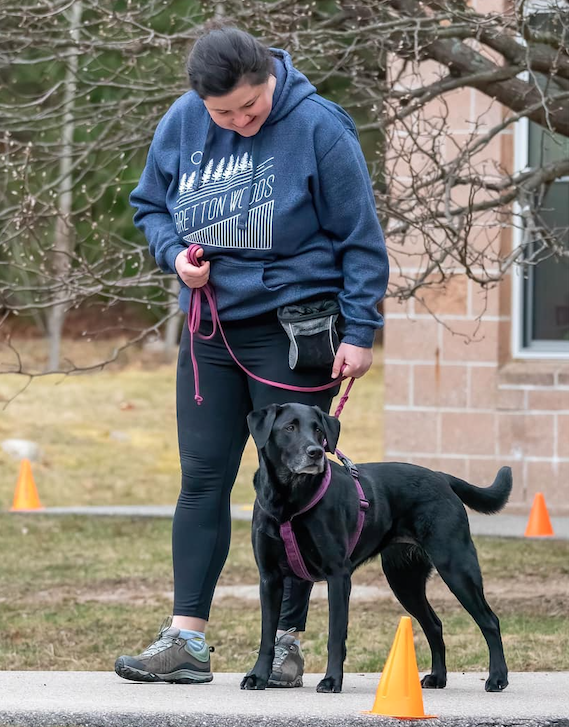
Emily explains what you are practicing and why it helps. Each skill is broken into small steps, you try the handling yourself, and you leave with a plan to follow between lessons.
- Marker or clicker training for clear timing
- Food, play, and praise as rewards
- Short, repeatable practice that fits your day
- Management, such as gates, leashes, and distance, to prevent setbacks
- Long-line foundations before any off-leash freedom
Does it work?
Reward-based training teaches the dog what to do, not only what to stop. It is where every plan at Canine Afloat begins, for puppies and adult dogs alike, including dogs with behavior problems.
Many owners notice early changes quickly. Strong reliability builds over several weeks of consistent practice, and it depends on practice between lessons. No honest trainer can guarantee a result or a timeline, because your dog’s history, health, and environment all play a part.
Is it safe for my dog?
Safety comes first in every plan. Sessions are set at a distance and intensity your dog can handle. With reactive dogs the focus is on safety, distance, and calm neutrality, and your dog will not be made to meet other dogs unless it is appropriate.
In day school, dogs are matched carefully in small groups and locations are chosen for what each dog can handle that day. Some dogs do best with parallel walks and structured social time, not play.
Tell Emily about any health concerns, bite history, or distress when left alone. Some problems need a more specific plan, and sometimes a conversation with your veterinarian.
Equipment
Most lessons need only a leash, a harness or flat collar, and small treats. A long line may be recommended for recall work.
E-collars are not a one-size-fits-all tool, and foundations always come first. We build recall, check-ins, and focus on a long line with positive reinforcement. If an e-collar might be appropriate for a dog and the goal, it is layered in only after those skills are solid, introduced gradually and with proper conditioning. Emily will talk through options and safety with you first, and you are always welcome to ask what is being used and why.
What we ask of you
Training works best when the people who live with the dog take part. Expect to practice for a few minutes at a time, ask questions, and tell Emily what is and is not working so the plan can be adjusted.
LET’S MAKE ROOM FOR BETTER DAYS
Questions about how we would work with your dog?
Tell Emily about your dog and what you want help with. She will explain the plan in plain language before you book.